Skip to content
  • Via API and webhooks

Connect WhatsApp to Make with Haiya's webhooks.

The same mechanism as Zapier, with Make's Custom webhook. Haiya posts its eight business events to the webhook's address, and a scenario starts a Haiya automation by calling an incoming-webhook URL. There is no Make module.

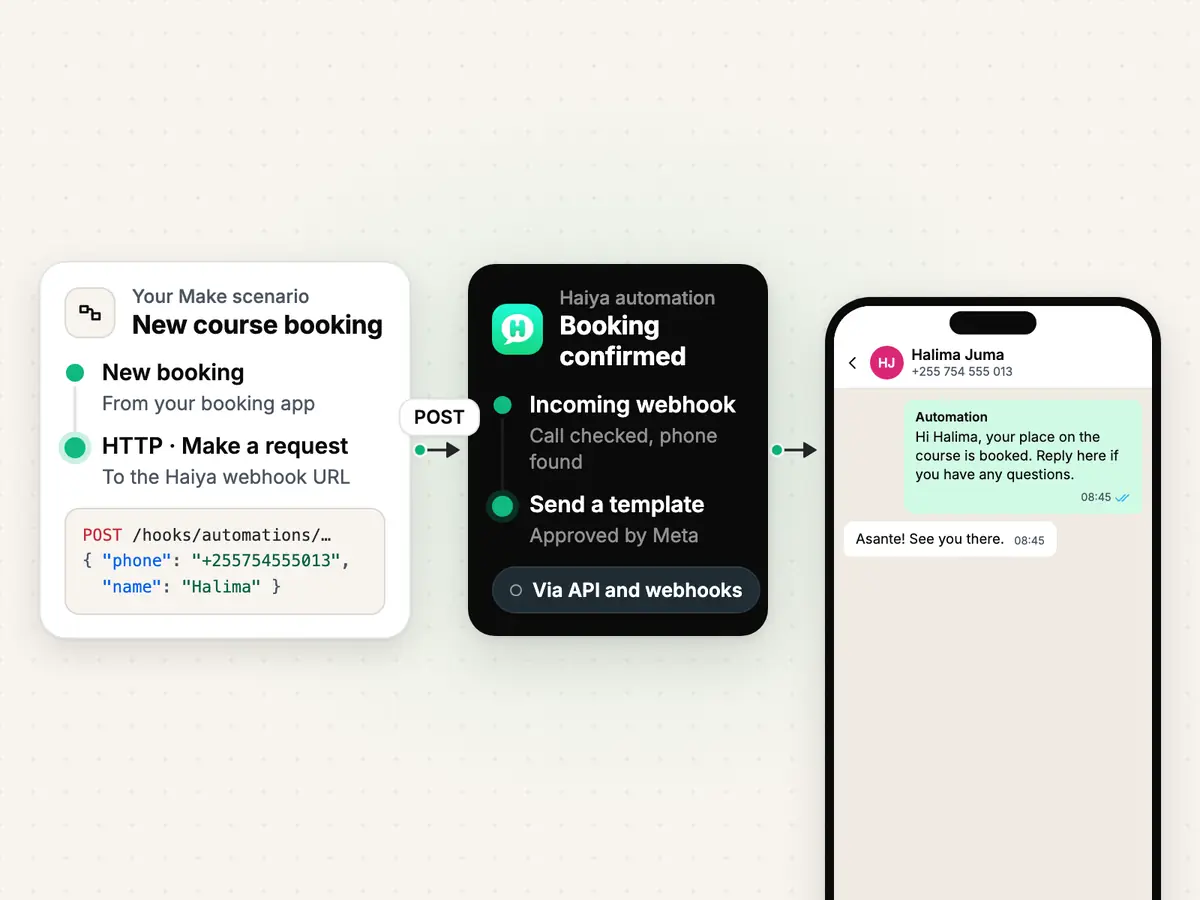
A Make scenario's HTTP module calling a Haiya webhook URL, the automation it starts, and the booking template in a WhatsApp chat

What you can do with Make and WhatsApp.

Haiya to Make

Run a scenario when something happens in Haiya.

Haiya sends eight business events: lead.created, lead.stage_changed, lead.owner_assigned, request.opened, request.status_changed, payment.received, order.placed and form.completed. You choose them on the web dashboard under Settings → Integrations → Webhooks & events.

  • Each delivery is a signed JSON POST to your Custom webhook
  • Pick the events per destination

Make to Haiya

Start a WhatsApp automation from a scenario.

When your scenario picks up a new course booking for Halima Juma (+255754555013), a Make a request module posts to a Haiya incoming-webhook URL with her phone number. Haiya checks the call and starts the automation, which can send her an approved WhatsApp template.

  • The body needs the customer's phone number
  • A repeated delivery is dropped

For developers

Send a message straight through the WhatsApp API.

The Haiya WhatsApp API takes requests shaped like Meta's Cloud API, with a Haiya API key. A Make a request module can call it like any other https API.

  • API keys are made by an owner or admin in Haiya
Read the API and webhook docs

What you need

  • A Make account.
  • An owner or admin in Haiya: only they can add an event destination.
  • The Haiya web dashboard: event destinations and automations are set up on the web.
  • A WhatsApp number connected in Haiya.

How to connect Make to WhatsApp with Haiya.

  1. Start a scenario with a Custom webhook

    In Make, start a scenario with the Webhooks app's Custom webhook module, add a webhook and copy its address.

    In the other tool
  2. Add it as an event destination

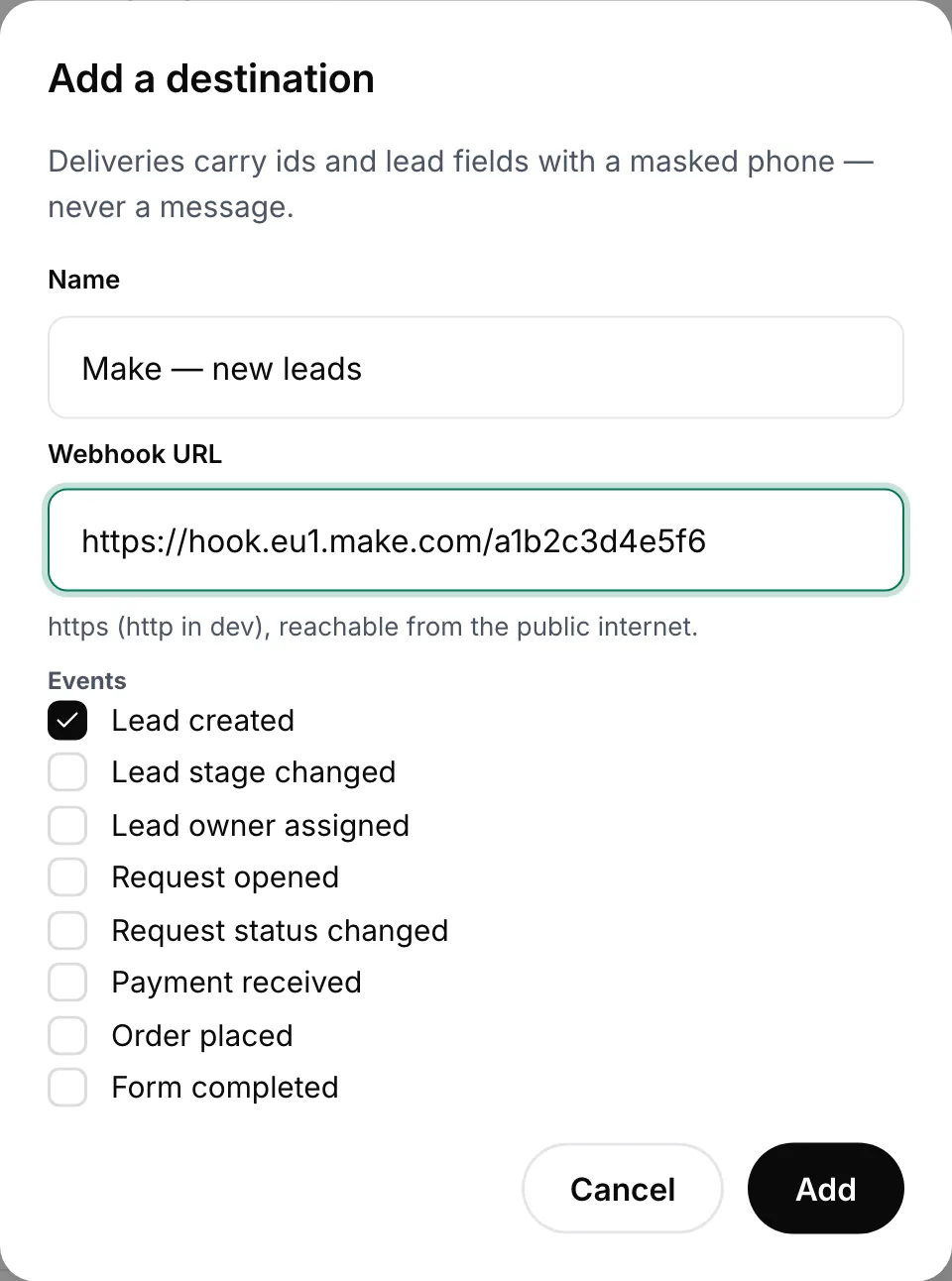
    On the Haiya web dashboard, open Settings → Integrations → Webhooks & events, add a destination, paste the Make address and choose which of the eight business events to send.

    In Haiya
    Add a destination dialog with a name, a Make webhook address and the business events to send
    Paste your Make webhook address and choose which business events to send.
  3. Keep the signing key

    Haiya shows the destination's signing key once. Keep it in your scenario if you check each delivery's X-Haiya-Signature-256 header.

    In Haiya
  4. Send a test event

    Use the destination's test button in Haiya. Make receives the event and learns its structure, so you can map the fields in the next modules.

    In Haiya and the other tool
  5. To go the other way, call Haiya

    Add the Incoming webhook trigger to a Haiya automation and copy its URL. In your scenario, the HTTP app's Make a request module posts to that URL with the customer's phone number.

    In Haiya and the other tool

How the data moves

  1. Haiya
  2. Your Make scenario
  3. Your other apps
  • Your Make scenario to Haiya: A POST to an incoming-webhook URL

Technical details.

The eight business events

  • lead.created
  • lead.stage_changed
  • lead.owner_assigned
  • request.opened
  • request.status_changed
  • payment.received
  • order.placed
  • form.completed

Each delivery to Make

  • POST, application/json
  • X-Haiya-Signature-256: sha256=<hex>
  • X-Haiya-Event-Type
  • id, event, occurredAt, workspaceId, data

Make pieces this guide uses

  • Webhooks: Custom webhook (trigger)
  • HTTP: Make a request

Calls from Make into Haiya

  • POST /hooks/automations/<token>
  • POST /whatsapp/<version>/<phone-number-id>/messages

What the Make connection does not do.

  • There is no Make module for Haiya: no Haiya app to pick inside Make. You use Make's own Webhooks and HTTP apps.
  • Haiya sends these eight business events and no others. A business event never carries a message body.
  • A phone number in a business event is masked to its country code and last four digits, so a scenario cannot message a customer from an event alone.
  • Up to 10 event destinations per workspace. Only owners and admins can add, change or remove one.
  • A delivery that fails is retried for up to 7 days. A destination that has failed without a break for the whole 7 days is switched off.
  • Every delivery is signed with X-Haiya-Signature-256, and a destination's signing key is shown once, when you create it.
  • An incoming-webhook URL needs the customer's phone number. Without one, nothing starts.

Questions about Make and WhatsApp.

Is there a Haiya module in Make?

No. There is no Make module for Haiya. You connect the two with Make's own Webhooks app, to receive Haiya's business events, and its HTTP app, to call Haiya.

Which Haiya events can start a scenario?

Eight business events: lead.created, lead.stage_changed, lead.owner_assigned, request.opened, request.status_changed, payment.received, order.placed and form.completed. You choose them per destination under Settings → Integrations → Webhooks & events.

Can a Make scenario send a WhatsApp message through Haiya?

Yes, in two ways. It can call a Haiya incoming-webhook URL to start an automation that sends an approved template, or it can call the Haiya WhatsApp API with an API key.

How does a scenario start an automation in Haiya?

Add the Incoming webhook trigger to the automation in Haiya and copy its URL, which is shown once. A Make a request module posts JSON to it with the customer's phone number, and Haiya starts the automation for that customer.

How do I check that a delivery came from Haiya?

Each delivery carries an X-Haiya-Signature-256 header: an HMAC-SHA256 of the body, made with the destination's signing key. Haiya shows that key once, when you create the destination.

Connect Make to WhatsApp with Haiya.

Start in the app, or book a demo and we will walk you through the set-up.

“…we use Haiya every day, and it has made team communication much easier.”

James Mwangi, Zinen TechnologiesTrustpilot
  • Get it on Google Play